SCIENTIFIC OVERVIEW
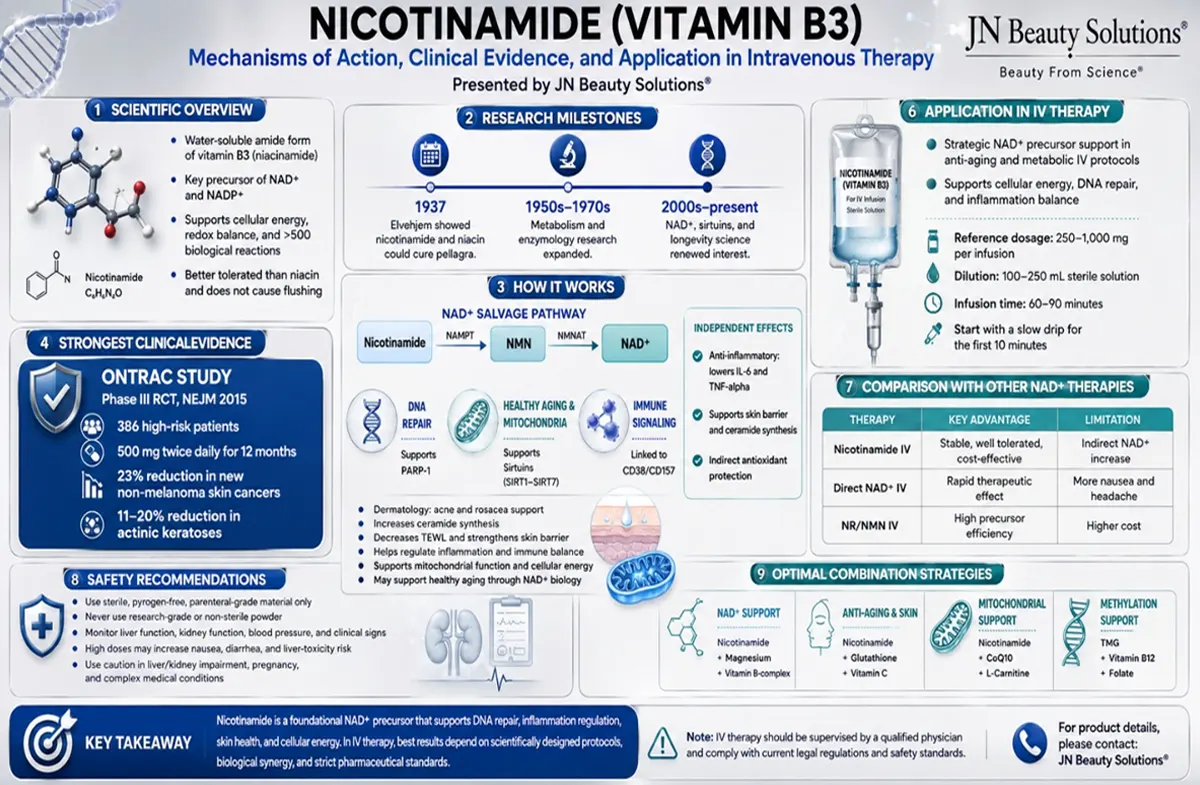
Nicotinamide (also known as niacinamide) is the amide form of vitamin B3 and belongs to the group of water-soluble vitamins. The compound has the chemical formula C₆H₆N₂O and a molecular weight of 122.12 g/mol. Nicotinamide is one of the most important precursors for the synthesis of NAD⁺ (nicotinamide adenine dinucleotide) and NADP⁺ – two coenzymes involved in more than 500 biological reactions in the body, particularly oxidation–reduction reactions and cellular energy production.
Unlike nicotinic acid (niacin), nicotinamide does not cause flush phenomenon (peripheral vasodilation leading to skin redness and flushing). It is better tolerated at high doses and is more suitable for medical, dermatological, and metabolic therapy applications. In modern medicine, nicotinamide is regarded as a foundational NAD⁺ precursor, playing a central role in strategies for anti-aging, DNA protection, immune regulation, and metabolic support.
RESEARCH HISTORY
Nicotinamide is closely linked to the discovery and treatment of pellagra – a highly fatal disease caused by vitamin B3 deficiency that was prevalent in the early 20th century. In 1937, Conrad Elvehjem (University of Wisconsin-Madison) demonstrated that both nicotinic acid and nicotinamide could cure pellagra in animals and humans, marking a major milestone in the history of nutrition.
From the 1950s to 1970s, research focused on the role of nicotinamide in enzymology and cellular metabolism. Since the early 2000s, the explosion of research on NAD⁺, sirtuins, and aging mechanisms has positioned nicotinamide as a key molecule in the fields of metabolic medicine and longevity science.
MECHANISM OF ACTION IN THE BODY
NAD⁺ Salvage Pathway
Nicotinamide serves as the primary substrate for the enzyme NAMPT (nicotinamide phosphoribosyl transferase) – the rate-limiting enzyme in the salvage pathway:
- Nicotinamide + PRPP → NMN (nicotinamide mononucleotide)
- NMN → NAD⁺ (via the enzyme NMNAT)
This is the main pathway that maintains intracellular NAD⁺ levels in most tissues.
Role of NAD⁺ in Cellular Biology
NAD⁺ acts as an essential cofactor for the following enzyme groups:
- PARP-1 (poly(ADP-ribose) polymerase-1): Detects and repairs DNA damage, protecting cells from oxidative stress.
- Sirtuins (SIRT1–SIRT7): Regulate gene expression, control the aging process, and support mitochondrial function.
- CD38/CD157: Participate in immune regulation and control inflammatory responses.
Independent Effects of Nicotinamide
In addition to its role as an NAD⁺ precursor, nicotinamide exerts direct effects:
- Anti-inflammatory action by reducing the expression of pro-inflammatory cytokines (IL-6, TNF-α).
- Stabilization of the skin barrier through increased ceramide synthesis.
- Indirect antioxidant effects.
- Inhibition of excessive PARP-1 activity at high doses, contributing to cellular protection in certain therapeutic contexts.
CLINICALLY RESEARCHED BENEFITS
Prevention of Non-Melanoma Skin Cancer (Strongest Evidence)
The ONTRAC study – a Phase III randomized controlled trial (RCT) published in the New England Journal of Medicine in 2015 – demonstrated clear efficacy:
- 386 high-risk patients.
- Dosage: 500 mg twice daily for 12 months.
- Reduced the risk of new non-melanoma skin cancer by 23% and reduced actinic keratosis by 11–20%.
This is one of the most convincing RCTs regarding nicotinamide in dermatology and oncology.
Dermatology and Skin Barrier Protection
Multiple randomized controlled trials have shown that nicotinamide (topical 2–5% or oral) helps:
- Reduce inflammatory acne and rosacea.
- Increase ceramide synthesis.
- Decrease trans epidermal water loss (TEWL).
Anti-Inflammatory and Immune Regulation
Nicotinamide inhibits the production of pro-inflammatory cytokines and supports immune balance, showing potential applications in chronic inflammatory diseases (Ungerstedt JS et al., Clinical Immunology, 2003).
Metabolism and Cellular Energy
Nicotinamide improves mitochondrial function, moderately supports insulin sensitivity, and reduces oxidative stress.
Aging and NAD⁺ Biology
Studies on NAD⁺ precursors (including nicotinamide riboside – NR) demonstrate the ability to increase intracellular NAD⁺ levels, improve cellular energy, and enhance cognitive function (Trammell SAJ et al., Nature Communications, 2016).
NICOTINAMIDE IN INTRAVENOUS (IV) THERAPY
Role in Modern IV Therapy
In IV protocols supporting anti-aging and metabolic health, nicotinamide rapidly supplies NAD⁺ precursors, supporting cellular energy production, DNA repair, and inflammation reduction. Nicotinamide IV is commonly used as a component of the “NAD⁺ support system.”
Reference Dosage in Clinical Practice
Based on literature and clinical experience:
- 250–1,000 mg per infusion.
- Diluted in 100–250 mL of sterile solution.
- Infusion time: 60–90 minutes. Slow drip rate (20 drips/second) for the first 10 minutes.
Comparison with Other NAD⁺ Therapies
Compared with other NAD⁺ therapies, nicotinamide IV is a stable precursor that offers excellent tolerability and reasonable cost, although it increases NAD⁺ levels indirectly. In contrast, direct NAD⁺ IV provides a rapid therapeutic effect but is more likely to cause discomfort such as nausea and headache. Meanwhile, NR/NMN IV acts as a highly effective precursor with superior bioavailability, albeit at a significantly higher cost.
SAFETY RECOMMENDATIONS FOR IV ADMINISTRATION
Raw Material Standards
- Mandatory: Must use sterile, pyrogen-free, parenteral-grade material (compliant with USP <797> and endotoxin testing).
- Absolutely prohibited: Research-grade or non-sterile powder (e.g., products intended only for laboratory research such as Gold Biotechnology N-640).
Infusion Rate and Monitoring
Infuse slowly to minimize nausea, headache, and hemodynamic disturbances. Monitoring should include:
- Liver function (liver enzymes).
- Kidney function.
- Blood pressure and clinical signs.
High Doses and Special Precautions
- Doses >1.5 g/day (oral equivalent) may cause nausea and diarrhea.
- Doses >3 g/day: Risk of liver toxicity.
- Use with caution in patients with liver or kidney impairment, pregnant women, and those with multiple underlying medical conditions.
OPTIMAL COMBINATION STRATEGIES IN IV THERAPY
To enhance efficacy and reduce side effects, nicotinamide is often combined in the following protocols:
- NAD⁺ Support Protocol: Nicotinamide + Magnesium + Vitamin B-complex.
- Anti-aging & Skin Protocol: Nicotinamide + Glutathione + Vitamin C.
- Mitochondrial Support Protocol: Nicotinamide + CoQ10 + L-Carnitine.
- Methylation Support: TMG (betaine) + Vitamin B12 + Folate (helps prevent homocysteine accumulation with long-term use).
CONCLUSION
Nicotinamide is one of the foundational molecules of modern biology, playing a critical role as an NAD⁺ precursor, supporting DNA repair, regulating inflammation, and protecting cells against aging.
Robust clinical evidence, particularly in the prevention of non-melanoma skin cancer and dermatological treatment, has confirmed the value of nicotinamide in medicine.
In intravenous therapy, nicotinamide is not merely a simple vitamin but a strategic component of the NAD⁺ support system. Optimal efficacy depends on scientifically designed protocols, tight biological synergy, and strict adherence to pharmaceutical standards (sterile, parenteral grade).
Note: Before applying for any IV therapy, patients should receive consultation and monitoring from a specialist physician. Use must comply with current legal regulations and safety standards.
For product details, please contact:
JN Beauty Solutions®
Beauty From Science
Selected References
- Chen AC et al. A Phase 3 Randomized Trial of Nicotinamide for Skin-Cancer Chemoprevention. N Engl J Med. 2015.
- Ungerstedt JS et al. Nicotinamide inhibits pro-inflammatory cytokines. Clin Immunol. 2003.
- Trammell SAJ et al. Nicotinamide riboside is uniquely bioavailable. Nat Commun. 2016.
- Knip M et al. Safety of high-dose nicotinamide. Diabetologia.
- Surjana D et al. Nicotinamide in dermatology. J Clin Dermatol.