
In recent years, consumers have become increasingly interested in ingredient lists and product labels. Terms such as “Paraben-Free,” “Sulfate-Free,” “Silicone-Free,” “Fragrance-Free,” “Clean Beauty,” and “Chemical-Free” have become common marketing claims across the beauty industry. While this growing awareness reflects a positive shift toward informed skincare choices, it has also led to widespread misconceptions and, in some cases, unnecessary fear surrounding certain ingredients.
The reality is that no ingredient is inherently good or bad. In modern cosmeceutical science, the safety and effectiveness of an ingredient depend on numerous factors, including concentration, formulation, delivery technology, intended use, quality control, manufacturing standards, and the individual characteristics of the user.
Surfactants: Not All Foaming Agents Are Harmful
Surfactants are essential components of cleansers, shampoos, and makeup removers because they help remove oil, dirt, and impurities from the skin. Ingredients such as Sodium Lauryl Sulfate (SLS) and Sodium Laureth Sulfate (SLES) are often criticized due to their potential to cause dryness or irritation in certain individuals.
However, this does not mean these ingredients are inherently unsafe. Their effects depend on the concentration used, the duration of contact with the skin, the overall formulation, and the condition of the skin barrier. A cleanser containing SLS may be perfectly suitable for healthy skin when balanced with moisturizing and soothing ingredients, whereas the same formulation may not be ideal for individuals with sensitive or compromised skin.
Hydroquinone: Highly Effective but Requires Appropriate Use
Hydroquinone remains one of the most extensively studied depigmenting agents for the treatment of melasma and hyperpigmentation. When used appropriately, it can deliver significant clinical benefits.
However, prolonged misuse or inappropriate application may increase the risk of irritation, rebound pigmentation, and, in rare cases, exogenous ochronosis.
It is important to emphasize that hydroquinone is not universally banned. In many countries, it continues to be used under prescription or professional supervision due to its proven efficacy in treating pigmentary disorders.
Retinoids: The Gold Standard in Anti-Aging and Acne Management
Retinoids, including Retinol, Retinal, Tretinoin, and other vitamin A derivatives, are among the most scientifically validated ingredients in dermatology and cosmetic science. They are widely used to improve photoaging, acne, and hyperpigmentation.
Despite their benefits, retinoids can also cause irritation, redness, dryness, and peeling, particularly during the initial stages of treatment. These adverse effects do not diminish their value. Instead, they highlight the importance of selecting the appropriate concentration, gradually increasing frequency of use, and supporting the skin barrier throughout treatment.
Alpha Hydroxy Acids and Beta Hydroxy Acids: Context Matters
AHA and BHA are highly effective exfoliating ingredients that have transformed modern skincare. However, the concentration, pH, formulation, and method of use significantly influence their safety profile.
For example, a cleanser containing 0.5% Salicylic Acid does not carry the same level of risk as a professional chemical peel containing 30% Salicylic Acid. Likewise, a low-concentration Glycolic Acid serum may be well tolerated for daily use, whereas high concentrations require professional supervision.
In cosmeceutical science, dosage and context are often more important than the ingredient name itself.
Preservatives: The Silent Guardians of Product Safety
Preservatives are among the most misunderstood ingredients in skincare. Parabens, Phenoxyethanol, Benzoic Acid, and Sorbic Acid are frequently portrayed negatively despite their critical role in maintaining product safety. Without an appropriate preservation system, cosmetic products can become breeding grounds for bacteria, yeast, and mold.
A product labeled “preservative-free” is not necessarily safer. In fact, inadequate preservation may result in microbial contamination that poses a much greater risk to consumers than the preservative itself.
Fragrances and Essential Oils: Neither Entirely Good nor Bad
Fragrances and essential oils can significantly enhance the sensory experience of a product, making formulations more enjoyable and increasing consumer compliance. However, for certain individuals, particularly those with sensitive skin, inflammatory skin conditions, or recently treated skin, these ingredients may increase the risk of irritation or allergic contact dermatitis.
Their suitability should therefore be evaluated based on concentration, formulation, and individual skin characteristics rather than broad generalizations.
Corticosteroids: Valuable Medicines but Inappropriate in Conventional Cosmetics
Topical corticosteroids are highly effective medications in dermatology and have an important role in treating inflammatory skin disorders. However, the illegal addition of corticosteroids to whitening creams and acne products remains a serious concern in many markets. Prolonged misuse may lead to skin thinning, telangiectasia, steroid-induced acne, rebound dermatitis, and steroid dependency.
It is important to understand that corticosteroids themselves are not “toxic” ingredients. They are highly effective therapeutic agents when prescribed and used appropriately.
Sunscreens and Nanotechnology
Nano Zinc Oxide and Nano Titanium Dioxide often generate unnecessary concerns due to misconceptions about nanotechnology. Current scientific evidence indicates that these materials are safe when properly manufactured and formulated for topical use.
Nanotechnology does not automatically imply toxicity. In many cases, nano-sized mineral filters improve cosmetic elegance, reduce whitening effects, and enhance user acceptance without compromising safety.
The Invisible Risks: Heavy Metals, Microbial Contamination, and Impurities
The quality of a cosmetic product cannot be assessed solely by its active ingredients.
Heavy metals such as lead, mercury, arsenic, cadmium, and nickel may be present as trace contaminants if raw materials are inadequately controlled.
Microorganisms including Staphylococcus aureus, Pseudomonas aeruginosa, Candida albicans, and molds can compromise product safety when manufacturing standards or preservation systems are insufficient.
Residual solvents, by-products, and manufacturing impurities must also be monitored through modern analytical techniques such as ICP-MS and GC-MS to ensure product purity and safety.
Product Quality Extends Beyond the Ingredient List
Two products containing the same active ingredient may not produce identical results. Manufacturing standards, raw material quality, supplier qualification, purification, methods, quality assurance systems, and delivery technologies can dramatically influence both efficacy and safety.
For example, encapsulated Retinol may provide greater stability and improved tolerability compared with conventional Retinol. Similarly, liposomal delivery systems can enhance the stability and performance of certain ingredients, including Vitamin C and peptides.
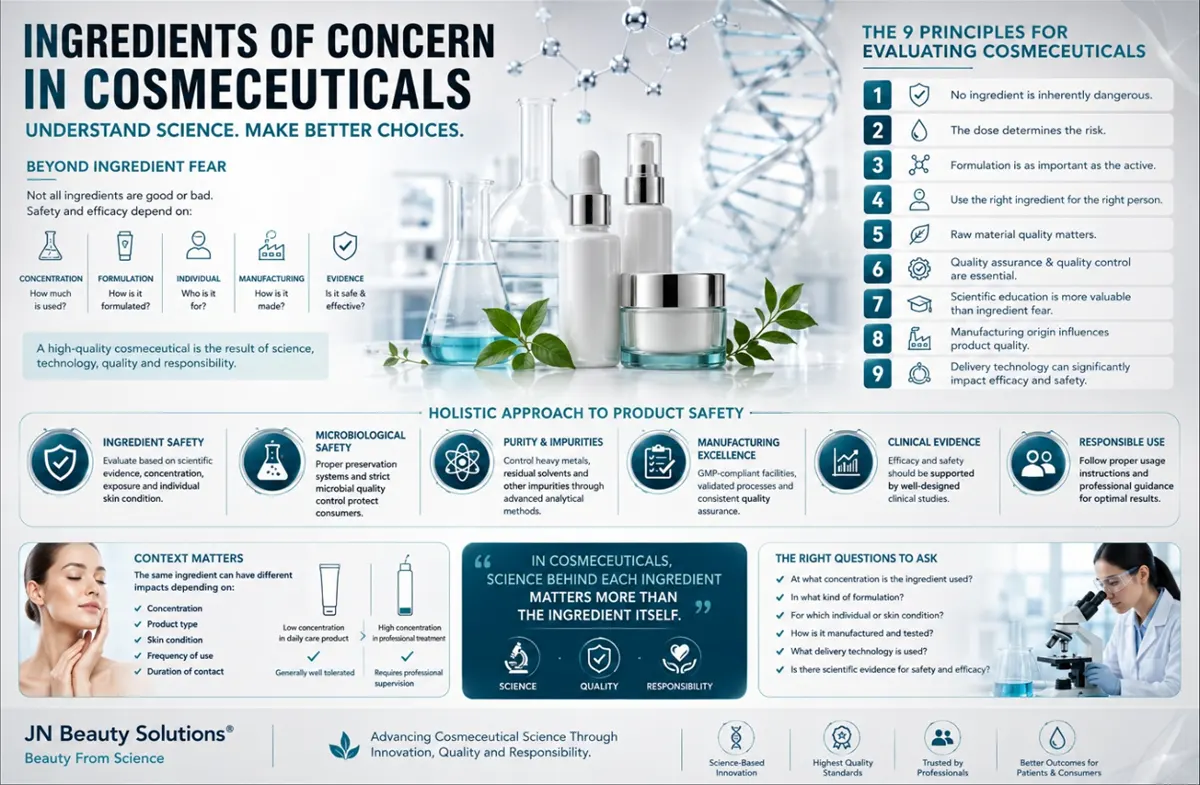
The Nine Principles for Evaluating Cosmeceuticals
A scientific evaluation of a cosmeceutical should consider the following factors:
- No ingredient is inherently dangerous.
- The dose determines the risk.
- Formulation is as important as the active ingredient.
- The right ingredient must be used for the right individual.
- Raw material quality matters.
- Quality assurance and quality control are essential.
- Scientific education is more valuable than ingredient fear.
- Manufacturing origin influences product quality.
- Delivery technology can significantly impact efficacy and safety.
Final Thoughts
In modern cosmeceutical science, the question should not be, “Is this ingredient dangerous?” Instead, we should ask:
- At what concentration is this ingredient used?
- In what type of formulation?
- For which individual?
- Under what manufacturing conditions?
- With what delivery technology?
- Has it been properly tested for safety and quality?
- Is there scientific evidence supporting its use?
A high-quality cosmeceutical is never defined by a single ingredient. It is the result of scientific formulation, advanced technology, rigorous quality control, responsible manufacturing, and a commitment to consumer safety.
Ultimately, the future of cosmeceuticals should not be built on ingredient fear, but on scientific understanding and evidence-based decision making. Because in modern skincare, the science behind an ingredient matters far more than the ingredient itself.
JN Beauty Solutions®
Beauty From Science
Advancing Cosmeceutical Science Through Innovation, Quality and Responsibility