
Vitamins and vitamin-related active ingredients play an important role in modern skincare thanks to their antioxidant properties, ability to support skin barrier repair, improve pigmentation, support anti-aging, and optimize the skin’s biological environment. Each vitamin has unique characteristics and is suitable for different skin types or aesthetic concerns. Choosing the right active ingredients and using them correctly will help optimize skincare results in a more scientific and safer way.
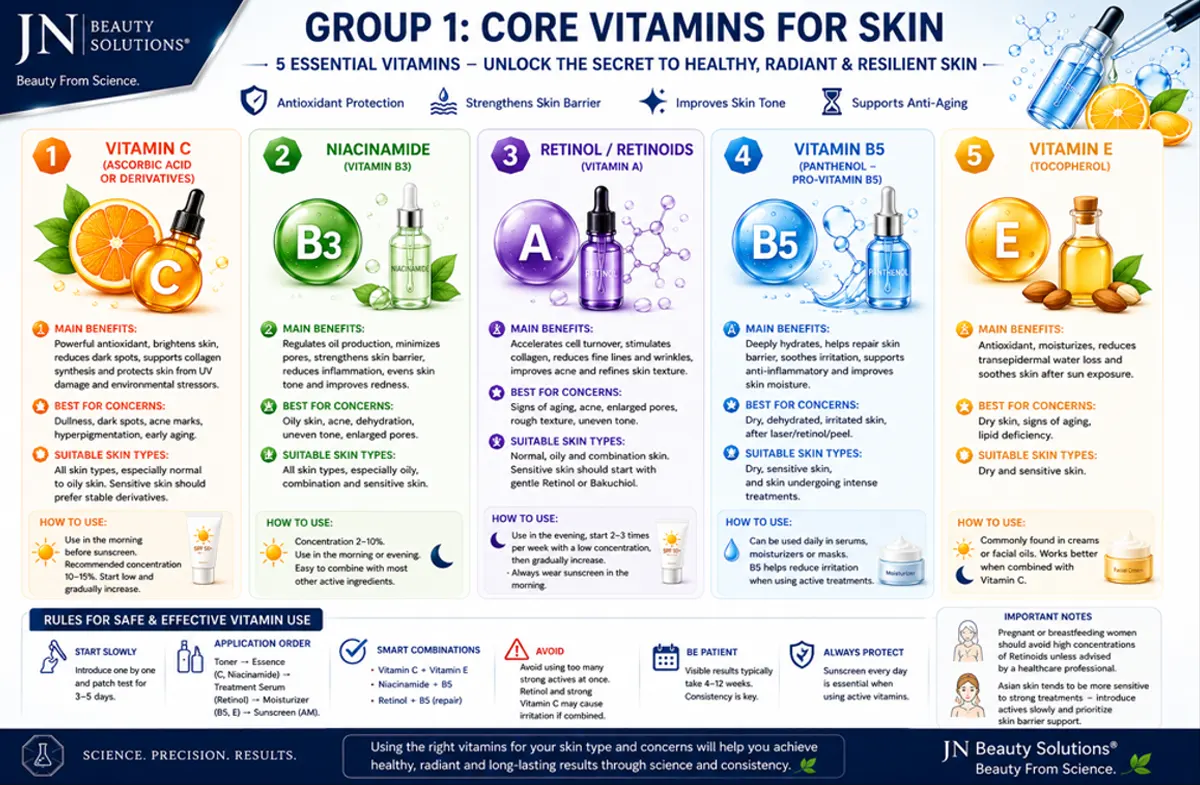
CORE VITAMINS IN SKINCARE
Vitamin C (Ascorbic Acid or Derivatives)
- Main benefits: Powerful antioxidant protection, supports skin brightening, reduces dark spots and hyperpigmentation, supports collagen synthesis, and protects the skin from oxidative stress caused by UV exposure and environmental pollution.
- Best for concerns: Dull skin, post-acne marks, mild melasma, early aging.
- Suitable skin types: Most skin types, especially normal and oily skin. Sensitive skin should prioritize stable derivatives such as Sodium Ascorbyl Phosphate or Ascorbyl Glucoside.
- How to use: Morning serum combined with sunscreen. Common concentrations range from 10–15%, gradually increasing depending on skin tolerance.
Niacinamide (Vitamin B3)
- Main benefits: Helps regulate oil production, minimize enlarged pores, strengthen the skin barrier, reduce inflammation, improve uneven skin tone, and support mild redness reduction.
- Best for concerns: Oily skin, acne-prone skin, dehydrated skin, uneven skin tone, visible pores.
- Suitable skin types: All skin types, especially oily and sensitive skin.
- How to use: Common concentrations range from 2–10%, used morning or evening. Easily combined with most other active ingredients.
Retinol / Retinoids (Vitamin A)
- Main benefits: Accelerates cellular turnover, stimulates collagen production, helps reduce wrinkles, improves acne, and smooths skin texture.
- Best for concerns: Aging, acne, enlarged pores, rough skin texture.
- Suitable skin types: Normal, oily, and combination skin. Sensitive skin should begin with gentle Retinol or Bakuchiol.
- How to use: Use at night, starting 2–3 times per week with a low concentration, then gradually increase. Always use sunscreen during the daytime.
Vitamin B5 (Panthenol – Pro-Vitamin B5)
- Main benefits: Deep hydration, supports skin barrier repair, soothes irritation, supports anti-inflammatory activity, and improves skin moisture levels.
- Best for concerns: Dry skin, dehydrated skin, irritated skin, post-laser/retinol/peel skin.
- Suitable skin types: Dry skin, sensitive skin, skin undergoing intensive treatments.
- How to use: Can be used daily in serums, moisturizers, or recovery masks. Vitamin B5 often acts as a “buffer” to help reduce irritation from active treatments.
- Vitamin E (Tocopherol)
- Main benefits: Antioxidant protection, moisturization, reduces transepidermal water loss, and helps soothe skin after sun exposure.
- Best for concerns: Dry skin, aging skin, lipid-deficient skin.
- Suitable skin types: Dry and sensitive skin.
- How to use: Commonly found in moisturizers or facial oils. Works more effectively when combined with Vitamin C.
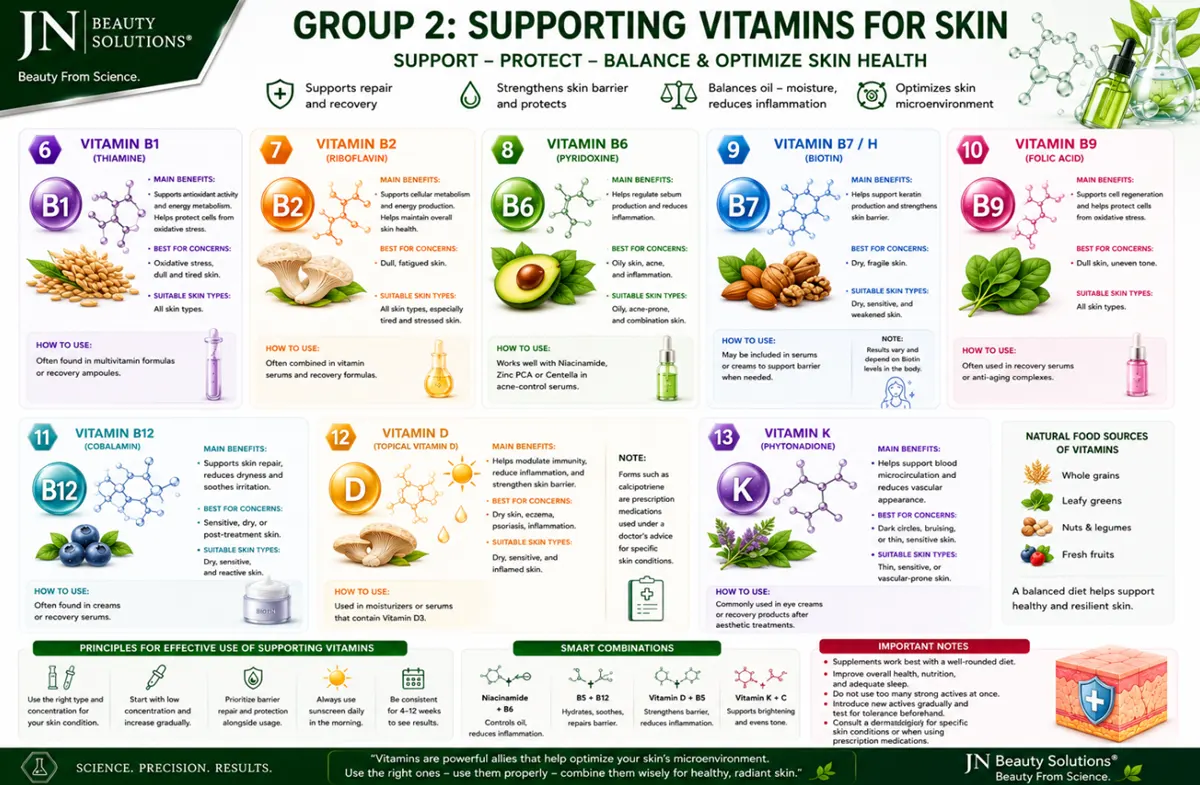
SUPPORTING VITAMINS IN SKINCARE
Vitamin B1 (Thiamine)
- Main benefits: Provides mild antioxidant support and supports cellular energy metabolism.
- Best for concerns: Oxidative stress, tired-looking skin.
- Suitable skin types: Most skin types.
- How to use: Commonly found in multivitamin formulations or recovery ampoules.
Vitamin B2 (Riboflavin)
- Main benefits: Supports cellular metabolic activity and overall skin health.
- Best for concerns: Dull skin, easily irritated skin.
- Suitable skin types: Sensitive or recovering skin.
- How to use: Commonly combined in multivitamin recovery serums.
Vitamin B6 (Pyridoxine)
- Main benefits: Helps regulate sebum production and supports mild anti-inflammatory activity.
- Best for concerns: Oily skin, acne-prone skin, inflammation-prone skin.
- Suitable skin types: Oily and combination skin.
- How to use: Commonly combined with Niacinamide, Zinc PCA, or Centella in acne-control serums.
Vitamin B7 / H (Biotin)
- Main benefits: Supports keratin synthesis, strengthens the skin barrier, and supports skin elasticity.
- Best for concerns: Dry skin, weakened skin, weak hair and nails.
- Suitable skin types: Skin requiring overall recovery support.
- How to use: May appear in serums or creams; oral supplements should only be used when necessary or under professional guidance.
- Note: The most noticeable benefits are typically seen in individuals with Biotin deficiency.
Vitamin B9 (Folic Acid)
- Main benefits: Supports cellular regeneration and recovery from oxidative stress.
- Best for concerns: Aging skin, dull skin.
- Suitable skin types: Skin needing repair and regeneration.
- How to use: Commonly found in recovery serums or anti-aging complexes.
Vitamin B12 (Cobalamin)
- Main benefits: Supports skin recovery, reduces dryness, and helps soothe irritation.
- Best for concerns: Sensitive skin, dry skin, post-treatment skin.
- Suitable skin types: Dry and sensitive skin.
- How to use: Commonly found in creams or recovery serums.
Vitamin D (Topical Vitamin D)
- Main benefits: Supports immune regulation within the skin, reduces inflammation, and supports the skin barrier.
- Best for concerns: Dry skin, eczema, psoriasis, inflamed skin.
- Suitable skin types: Dry, sensitive, and inflamed skin.
- How to use: Used in moisturizers or serums containing Vitamin D3.
- Note: Prescription forms such as calcipotriene are primarily used for skin disorders under medical supervision.
Vitamin K (Phytonadione)
- Main benefits: Supports microcirculation, reduces bruising, and helps improve vascular-type dark circles.
- Best for concerns: Dark under-eye circles, thin skin prone to bruising, post-laser/treatment skin.
- Suitable skin types: Thin and sensitive skin around the eyes.
- How to use: Commonly used in eye creams or post-treatment recovery products.
PRINCIPLES FOR SAFE & EFFECTIVE VITAMIN USE
- Start slowly (introduce one by one) and perform a patch test for 3–5 days.
- Apply skincare from thin to thick textures: Toner → Lightweight serum (Vitamin C, Niacinamide) → Treatment serum (Retinol) → Recovery moisturizer (B5, E, K) → Daytime sunscreen.
- Common combinations: Vitamin C + Vitamin E | Niacinamide + B5 |Retinol + Recovery B5
- Avoid using too many strong active ingredients simultaneously on sensitive skin.
- Strong Retinol and strong Vitamin C are often best separated into morning/evening routines to reduce irritation risk.
- Most active ingredients require 4–12 weeks to show noticeable results.
- Pregnant women should avoid high-concentration Retinoids unless professionally advised.
- Asian skin tends to be more sensitive to aggressive treatments, so active ingredients should be introduced gradually, and sunscreen should always be used.
In modern skincare, not every vitamin acts as a “hero ingredient.” Some vitamins function as supportive ingredients that help optimize the skin barrier, reduce oxidative stress, or improve the skin’s biological environment. Actual effectiveness depends on the overall formulation, active concentration, delivery technology, and compatibility with individual skin types.
Using the right vitamins according to your skin type and aesthetic concerns will help optimize skincare results in a more scientific, safe, and sustainable way.
JN Beauty Solutions®
Beauty From Science.